POPS: Misspecification-aware regression
POPS is an efficient and rigorously grounded UQ method for misspecified (imperfect) surrogate models which avoids the overconfidence of Bayesian regression. POPS is primarily designed for the following setting, where existing methods fail:
-
ground truth is near-deterministic (weak aleatoric), e.g. computational surrogates (MLIPs, O/PDE integrators)
-
beyond one-shot error estimation, uncertainty must be propagated downstream, requiring parameter posteriors
-
we desire tight coverage bounds to assess worst-case parameter values
Any scheme minimizing the expected loss, including Bayesian approaches, provably ignores misspecification. Conformal methods can provide calibrated error estimates but cannot assign this to parameter distributions suitable for propagation through complex workflows. POPS provides an efficient scheme which gives naturally calibrated errors through parameter posteriors, ideally suited for multi scale propagation.
This website details the underlying theory; see quick start for details on the Python and Julia implementations.
How POPS works · Algorithm · Paper
Online demo from Kermode group (Warwick) here
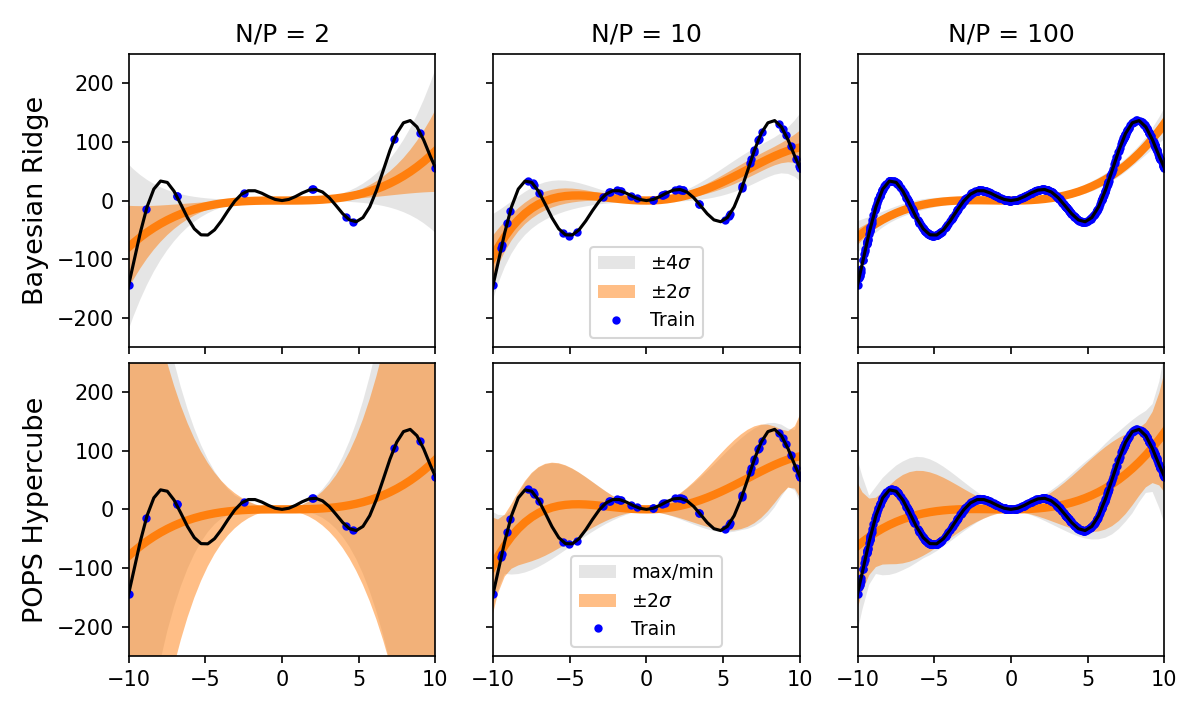
A quartic polynomial (P = 5) fitted to an oscillatory target as the data grow. Top: the Bayesian Ridge posterior overconcentrates around the best fit model parameters, ignoring model-form errors. bottom: the POPS hypercube posterior keeps uncertainty where the best fit model cannot interpolate training data.
Quick start
from popsregression import POPSRegression

model = POPSRegression().fit(X_train, y_train)

# y_std combines misspecification and epistemic uncertainty
y_pred, y_std = model.predict(X_test, return_std=True)
POPSRegression is a scikit-learn estimator, so it drops into pipelines
and hyperparameter search unchanged.