Example: POPS vs BayesianRidge
A runnable comparison of POPSRegression and
BayesianRidge
on a misspecified, low-noise fit. For why the two differ, see
Concepts on the POPS site; for
the options used here, see Usage.
The full script is available in the repository under
examples/plot_pops_regression.py.
A misspecified, low-noise problem
We create a target function that a 4th-degree polynomial cannot perfectly reproduce. This is the misspecification: the model is structurally unable to capture the true function, regardless of how much data we have.
import numpy as np

rng = np.random.RandomState(42)


def target_function(x):
    return (x**3 + 0.01 * x**4) * 0.1 + np.sin(x) * x * 10.0


x_test = np.linspace(-11, 11, 200)
y_test = target_function(x_test)
Fitting at increasing training set sizes
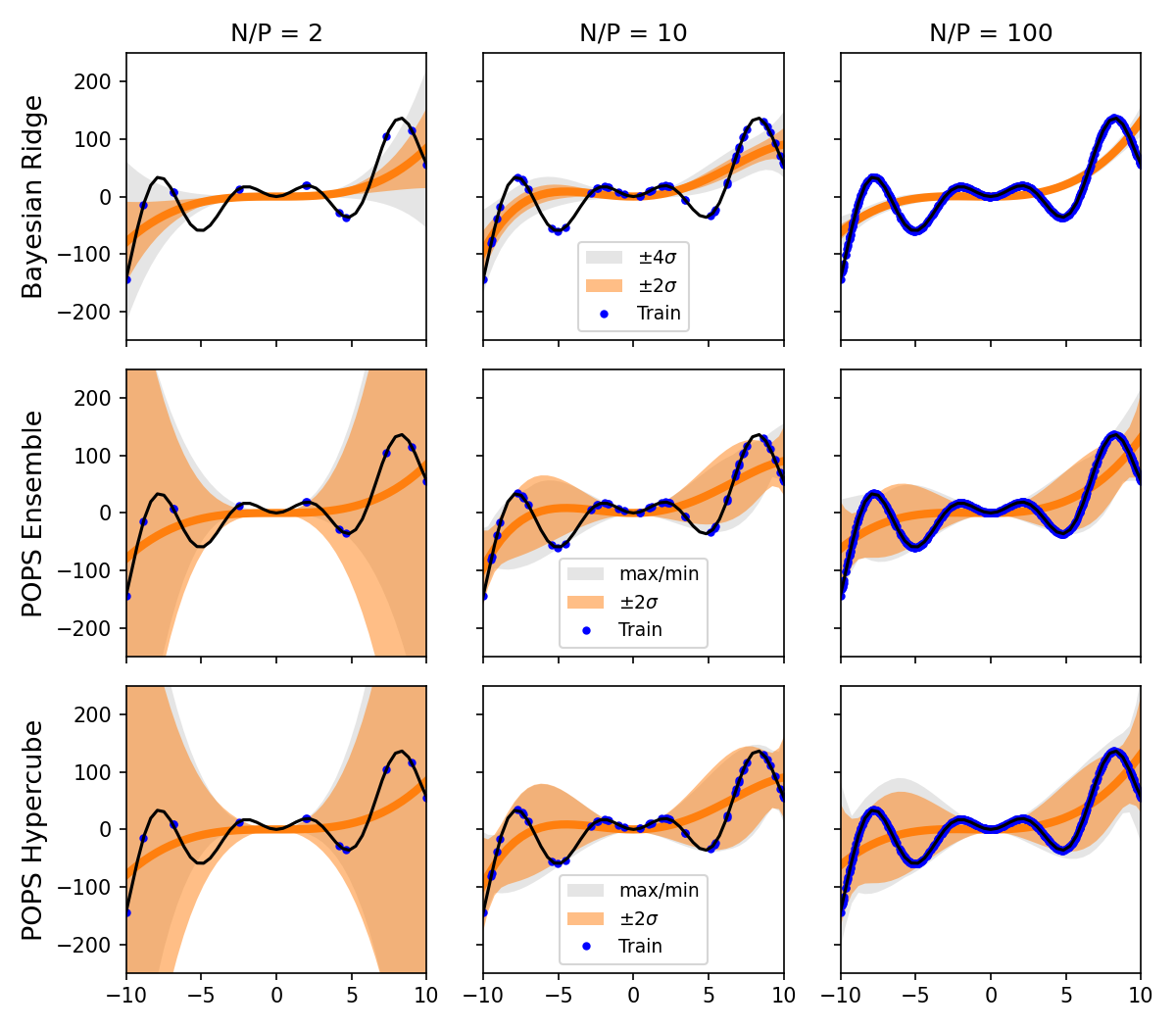
We compare POPSRegression and BayesianRidge for N = 10, 30, 500 training
points. As N increases, the BayesianRidge epistemic uncertainty shrinks to
near-zero, but the POPS misspecification uncertainty persists because the
polynomial is fundamentally unable to fit the target.
from sklearn.linear_model import BayesianRidge
from sklearn.preprocessing import PolynomialFeatures

from popsregression import POPSRegression

for n_samples in [10, 30, 500]:
    # Generate training data (no noise — purely deterministic)
    x_train = np.sort(
        np.append(rng.uniform(-1, 1, n_samples), np.linspace(-1, 1, 2)) * 10
    )
    y_train = target_function(x_train)

    poly = PolynomialFeatures(degree=4, include_bias=True)
    X_train = poly.fit_transform(x_train.reshape(-1, 1))
    X_test = poly.fit_transform(x_test.reshape(-1, 1))

    # POPS Regression: mean, combined std, and min/max posterior bounds
    pops = POPSRegression(resampling_method="sobol", resample_density=10.0)
    pops.fit(X_train, y_train)
    y_pred, y_std, y_max, y_min = pops.predict(
        X_test, return_std=True, return_bounds=True
    )

    # BayesianRidge (epistemic uncertainty only, excluding aleatoric alpha_)
    br = BayesianRidge(fit_intercept=False)
    br.fit(X_train, y_train)
    br_pred = br.predict(X_test)
    br_epistemic_std = np.sqrt(np.sum(np.dot(X_test, br.sigma_) * X_test, axis=1))
Plotting the POPS ±2σ band (orange), the POPS min/max envelope (grey), and the
BayesianRidge epistemic-only ±2σ band (green) against the truth (black)
produces the following comparison.
Result
- N = 10: Both methods show wide uncertainty, but POPS is wider and provides better coverage of the true function.
- N = 30: The
BayesianRidgeepistemic uncertainty has already shrunk significantly, while POPS correctly maintains wider bands where the polynomial deviates from the truth. - N = 500: The
BayesianRidgeepistemic uncertainty is nearly invisible, yet the polynomial still cannot match the oscillatory target. POPS maintains honest uncertainty that reflects this structural limitation.
For low-noise misspecified models, more data reduces only the epistemic component of the uncertainty; POPS captures the misspecification component that remains.
Posterior types
POPSRegression supports two posterior forms over the pointwise corrections:
'hypercube'(default): fits a PCA-aligned hypercube to the corrections, giving conservative bounds suitable for most use cases.'ensemble': uses the raw pointwise corrections directly as posterior samples.
minimum_relative_error=0.0 below keeps every training point in the posterior
estimate rather than only those the model fits poorly.